.png)






We have a database of over 11,000 colleges all over India.
Connect with us to find your perfect fit!
Blog
18 September,2026 | By Brainwonders
Choosing an academic stream after Class 10 or a career path after Class 12 is one of the most important decisions in a student’s life. However, students often make these choices based on board-exam marks, family expectations, peer pressure, popular career trends, or limited knowledge about available options.
This can leave bright and capable students pursuing paths that do not reflect their true strengths, interests, or preferred ways of learning.
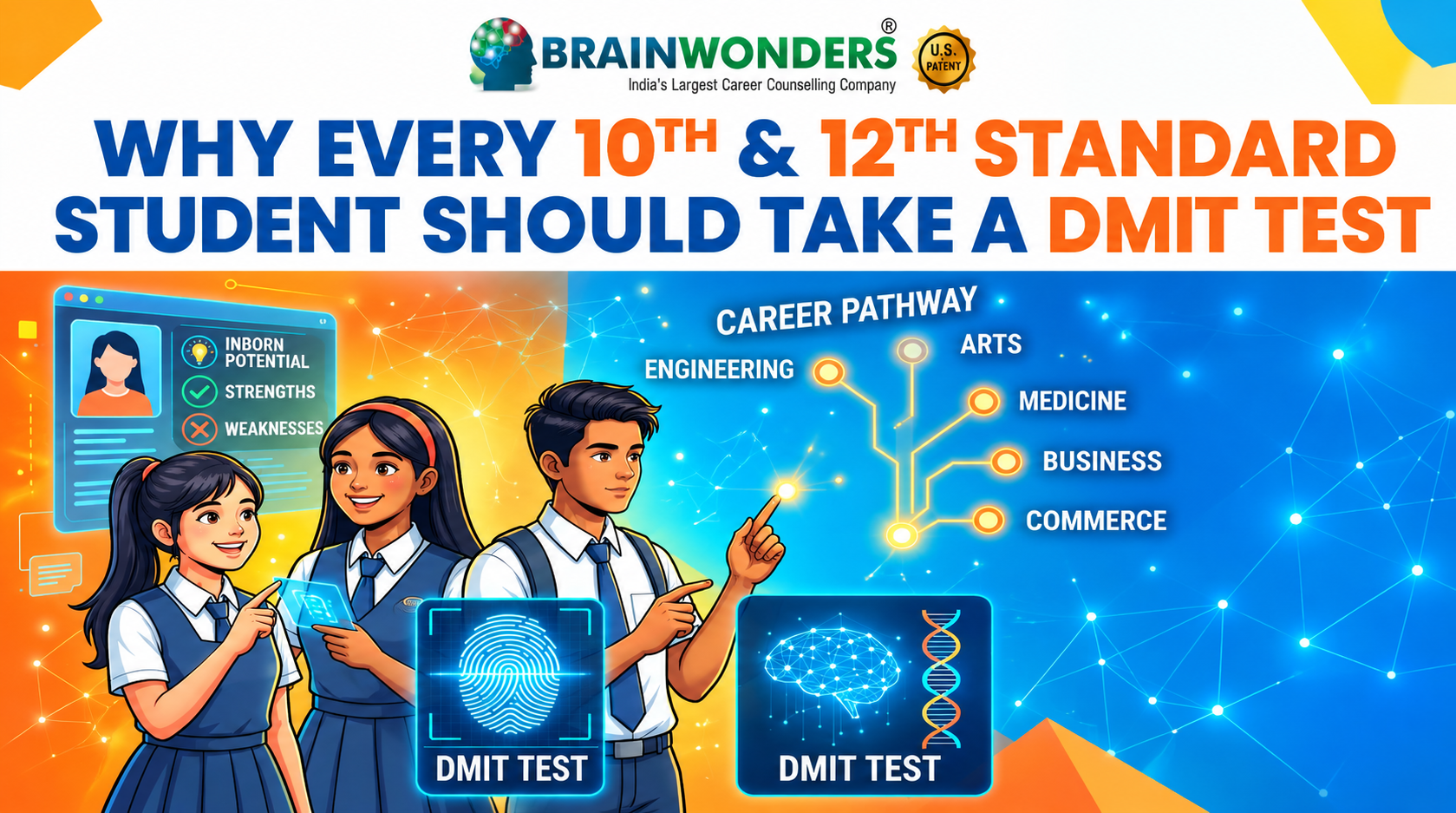
A DMIT assessment for students can help begin a more thoughtful career-planning conversation. Used with professional counselling, academic performance, interests, personality, and real-world career exposure, it may guide parents and students toward more informed decisions.
What Is DMIT?
DMIT stands for Dermatoglyphics Multiple Intelligence Test. It is based on the scientific study of fingerprint ridge patterns, known as dermatoglyphics, and their possible relationship with learning preferences and multiple forms of intelligence.
The basic principle behind this approach is that fingerprint patterns begin forming during fetal development and remain unchanged throughout a person’s life. DMIT practitioners examine these patterns to offer insights into areas such as:
DMIT is used by many counsellors as an assessment-based guidance tool to help students better understand learning preferences, strengths, and possible career directions. It should not be presented as a scientifically proven method for determining a child’s future, diagnosing a condition, or replacing a professional aptitude or psychological assessment.
Why Is DMIT Useful After the 10th Standard?
After Class 10, students are generally expected to choose between Science, Commerce, Humanities, and vocational or skill-based pathways. Because changing streams later can involve additional time, effort, and expense, the decision should be made with care.
Unfortunately, high marks in one subject do not always mean that a particular academic stream or profession is the right fit. For example:
A properly interpreted DMIT test for 10th students can provide another perspective by highlighting possible learning preferences, strengths, and areas of interest.
It can help students and parents ask more meaningful questions:
The purpose is not to label a child or make a final decision for them. The purpose is to support a more balanced discussion about stream selection.
Why Is DMIT Useful After the 12th Standard?
The pressure to choose the right path becomes greater after Class 12. Students may be preparing for entrance examinations such as JEE, NEET, CUET, design tests, law entrance exams, or other professional programmes.
At this stage, many students know which examination they are preparing for but may not be sure whether the profession connected to it suits their abilities, interests, or working style.
A DMIT test for 12th students can support career exploration by encouraging discussion about:
For example, a student who shows strong spatial interests may explore architecture, interior design, urban planning, animation, game design, or environmental planning. However, an assessment should not be used to conclude that one profession is the only suitable choice.
Career decisions should also consider subjects studied, academic performance, co-curricular interests, work experience, personal values, financial considerations, and the student’s own goals.
DMIT Helps Parents Look Beyond Marks
Marks are important, but they measure performance in a particular academic format. They may not fully explain how a child learns, what motivates them, or the environments in which they are most likely to grow.
DMIT-based guidance can encourage parents to consider questions that are often overlooked:
This information can help parents move away from comparisons with other children and focus on the individual needs of their son or daughter.
Six Key Benefits of DMIT for 10th and 12th Students
1. More Thoughtful Stream Selection
Understanding possible strengths and learning preferences can help families compare Science, Commerce, Humanities, and vocational options more thoughtfully.
2. Greater Awareness of Learning Style
A report may suggest that a student is more likely to benefit from visual, auditory, reading-and-writing, or hands-on learning. Parents can then use this insight to improve study routines instead of relying on one method for every child.
3. Better Career Exploration
Students do not have to choose immediately from hundreds of careers. They can create a shortlist of fields to investigate based on their interests, academic strengths, learning preferences, and future goals.
4. Fewer Conflicts at Home
Career discussions can become emotional when parents and children have different expectations. An assessment-based report may provide a neutral starting point and make the conversation calmer, clearer, and more collaborative.
5. Better Understanding of the Child
A structured report may help parents identify possible preferences related to communication, reflection, social interaction, and practical work. This can lead to better educational and emotional support.
6. Improved Clarity and Confidence
When students understand their strengths and have the opportunity to explore relevant careers, they may feel more confident about their next steps.
Why Parents Should Approach DMIT Carefully
Parents understandably want their children to have secure and successful futures. However, the best career decision is not always the most popular one. Engineering, medicine, law, government services, business, and other established careers may not suit every child.
A responsible assessment should help start a conversation—not provide a fixed prediction about a child’s future.
DMIT should not:
DMIT should be used as one part of a broader student career guidance process. The assessment should be followed by a qualified counsellor’s interpretation, practical career exploration, and an open family discussion.
Why Is This Stage So Important?
The choices made during Classes 9, 10, 11, and 12 can influence a student’s subjects, college options, entrance examinations, higher-education path, and eventual career direction.
Early guidance can help families:
The goal is not to choose a career too early. It is to help the child understand their interests, build relevant skills, and gradually make better-informed academic decisions.
DMIT, Career Counselling, and Practical Exposure: The Right Approach
No single test can know exactly what a child should become. A more reliable approach combines:
For families seeking career counselling for students, it is important to choose a service that provides balanced guidance rather than making exaggerated claims.
Parents can begin by Појединачнаավարարby exploring the Brainwonders official website to learn more about available assessment and counselling options.
Final Thoughts
Choosing a stream after Class 10 or a career after Class 12 should not depend only on marks, peer pressure, family assumptions, or social media trends. Every child has a different combination of abilities, interests, values, and learning preferences.
A DMIT assessment may help parents and students begin a structured conversation about strengths and future possibilities. When its results are interpreted responsibly and combined with counselling, academic history, practical exposure, and the child’s own goals, it can become a useful part of career planning.
The aim is not to place a label on a child. It is to help the child build self-awareness, explore suitable opportunities, and make confident decisions about their future.
Help Your Child Choose the Right Path
If your child is approaching Class 10 or Class 12 and feels confused about stream or career selection, early guidance can make a meaningful difference. Explore professional DMIT assessment and career counselling at Brainwonders to understand strengths, learning preferences, and possible career paths.
The most effective decision is one that combines a child’s potential with informed choices, practical exposure, and sustained family support.
Fill the form to know how!
.webp)






.png)